

Chocolate Sugar Bloom Explained: Causes and Prevention
Sugar bloom and fat bloom are surface defects that change chocolate's appearance and texture, not its safety. The pattern and feel of the pale patches help you tell which defect you're looking at.
If a bar turns white after refrigeration, was the problem really the cold, or the moisture that reached it when you opened the wrapper? That distinction matters. Chocolate sugar bloom follows a moisture pathway, while fat bloom involves changes in cocoa butter.
At Fresco Chocolate, we approach questions like this as chocolate makers who enjoy understanding the mechanics. A pale bar isn't automatically spoiled, and a refrigerator isn't automatically the culprit. A few practical checks can help you identify what happened, prevent another occurrence, and put that chocolate to good use.
Sugar Bloom vs Fat Bloom at a Glance
Sugar bloom usually looks dusty and feels gritty. Fat bloom more often looks gray or streaky and feels smooth or waxy. Both can leave pale patches, so appearance alone rarely settles the diagnosis.
Sugar bloom versus fat bloom at a glance
| Feature | Sugar bloom | Fat bloom |
|---|---|---|
| Appearance | Spotty, dusty or gritty pale patches | Grayish or whitish streaks or a dull film |
| Pattern | Uneven, spotty patches, often where moisture touched | Usually spreads across the whole bar; can also appear in isolated spots |
| Texture | Rough, sandy or dry-feeling | Smooth, waxy or greasy-feeling |
| Main cause | Moisture dissolves surface sugar, which then recrystallizes | Cocoa butter melts or changes crystal structure and recrystallizes after temperature swings |
| Typical trigger | Condensation, humid air or moving chilled chocolate into warm air | Heat, direct sun, a warm car or repeated warm-cool cycles |
| Response to warmth | Sugar crystals stay gritty and don't melt away readily | The fat deposit softens and melts when warmed |
| Spoilage sign? | No, a surface defect | No, a surface defect |
The distinction between crystalline sugar deposits and cocoa-fat bloom is explained in Peter's Chocolate's guide to understanding bloom, which describes sugar bloom as a rough deposit that doesn't readily melt with warmth. That makes a gentle touch check useful alongside a photograph.
Read the surface and the storage history
A photo of a pale bar is a useful first clue. The follow-up happens off-camera: one touch, then a short mental review of where the chocolate has been.
With a clean, dry fingertip, gently touch a small affected area. A sandy feel points toward sugar; a smooth, waxy feel points toward fat. Keep the check small and dry, since wetting the bar would add the very moisture that sets sugar bloom in motion.
Treat a photo as a first clue, then confirm with the touch test and the bar's storage history.
Reconstruct the bar's recent past: time in the refrigerator, a spot beside the stove, a delivery parcel, a sunny counter. Where the patches sit on the surface matters less than matching that history to the likely trigger, so let the storage story guide what you change next.
How Sugar Bloom Forms on the Surface
A cold chocolate bar carried into a humid kitchen collects a thin film of moisture almost immediately. You might barely notice it before it dries.
That small amount of water can do quite a bit. The Institute of Food Technologists' explanation of confectionery crystallization describes how surface moisture dissolves sugar and leaves a pale, rough deposit once the water evaporates. Water does all the work in this pathway; warmth never enters the picture, which is what separates it from the heat-driven route behind fat bloom.
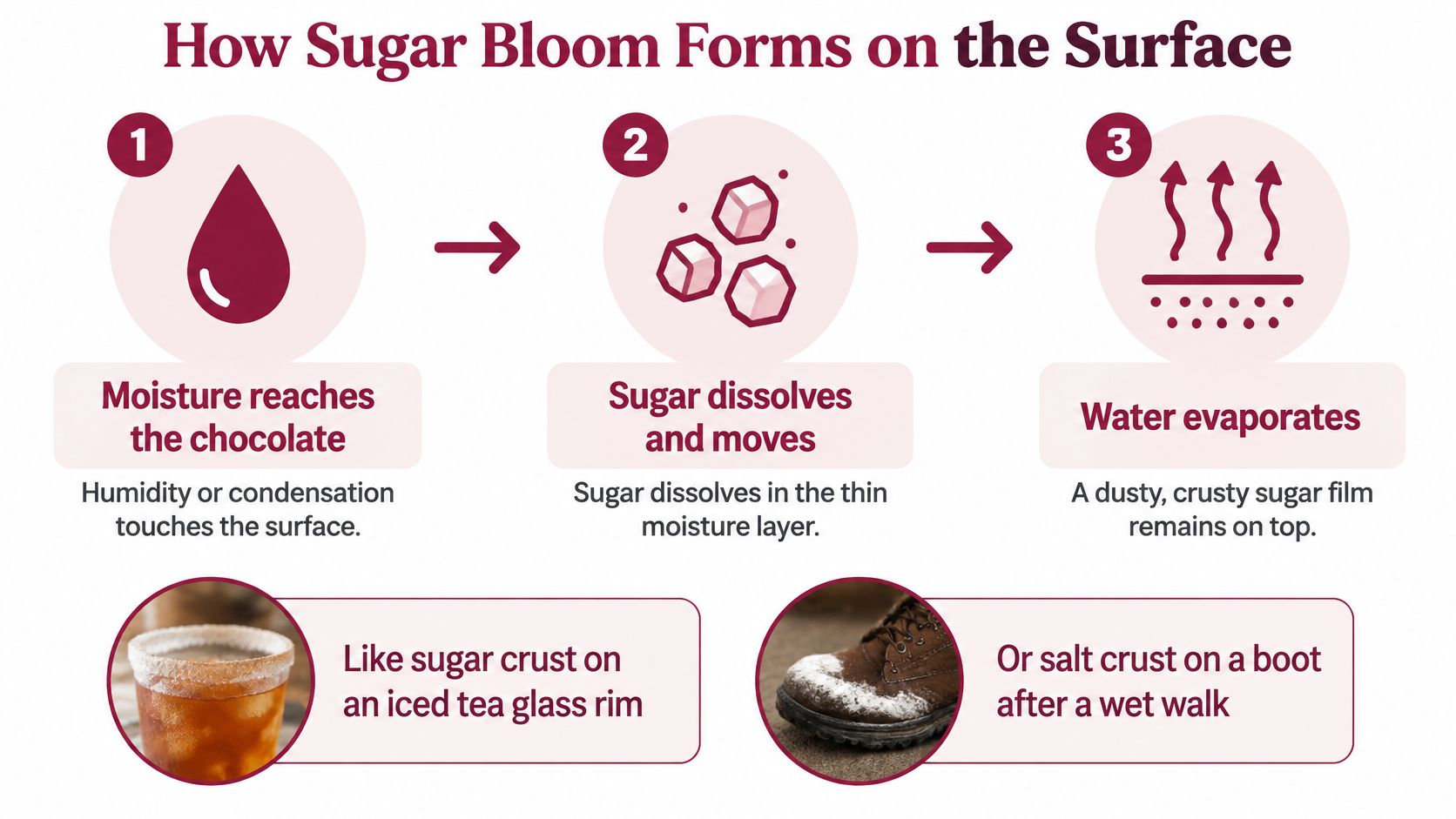
Follow the water
- Moisture reaches the surface. Condensation or humid air supplies water to the outside of the chocolate.
- Surface sugar dissolves. The water picks up some sugar, letting it move freely within that thin wet layer.
- The surface dries. Water evaporates, and the dissolved sugar has nowhere to go.
- Sugar recrystallizes. It settles back as larger, irregular crystals sitting on top of the chocolate rather than inside it.
- The coating becomes noticeable. You see a pale, dusty layer and may feel a grainier or drier surface when tasting.
The result resembles the sugar crust on the rim of a sweetened iced tea glass after the liquid dries: the same sugar, dissolved, carried a short distance and left behind in a new arrangement.
Our dark chocolate is made from cocoa beans, cane sugar and cocoa butter, and in a sweetened bar the cane sugar is what the water carries to the surface. An unsweetened chocolate, like our 100% chocolate, has no cane sugar for water to move, so this particular defect has little to work with there.
Why the inside can remain stable
Chocolate has low water activity, a measure of how available its water is for reactions and microbial growth. A brief film on the outside can still dissolve and shift surface sugar while the interior remains comparatively unchanged.
Sugar bloom is a physical crystallization defect. The pale layer is the bar's own sugar in a new arrangement, so the practical correction is to control surface moisture and packaging conditions rather than assume the recipe needs changing. In production, that means checking cooling and packing conditions so finished chocolate doesn't collect condensation before it's wrapped.
Storage Routine for Bars and Medallions
Keep chocolate in a cool, dry place away from direct sunlight, protected by its original wrapper or a tightly sealed container. Choose a shelf where conditions stay steady, not one that feels cool when you happen to check it.
Storage routine by product
| Product | Where to store | Keep sealed? | Main habit |
|---|---|---|---|
| Unsweetened medallions for baking | Cool, dry pantry away from direct sunlight | Yes, reseal after every use | Scoop with a dry spoon and close the bag right away |
| Unopened single-origin dark bars | Cool, dry pantry away from direct sunlight | Yes, in the original wrapper | Keep the wrapper intact until the bar is needed |
| Opened single-origin bars | Cool, dry spot away from humid areas | Yes, rewrap tightly after tasting | Rewrap after each tasting session |
| Tasting flight bars | Cool, dry pantry away from direct sunlight | Yes, keep the bars wrapped | Open one bar at a time |
Single-origin means the cacao comes from a particular origin rather than a blend of origins. It doesn't change the basic storage approach: protect the chocolate's surface while preserving the flavor you want to taste.
A Wageningen food-packaging case document summarizes a study of eight chocolate products stored for 18 weeks at 6, 12, 20 and 30 °C, with blooming least prominent at the lower tested temperatures and prominent sugar bloom at 30 °C; it also identifies relative humidity above 65% as a practical risk zone. These are useful warning signs, not a promise that every bar behaves identically at a particular reading.
Check the moisture barrier
A wrapper isn't just there to keep fingerprints off the chocolate. It helps limit moisture exchange. Look for tears, loose folds and seals that haven't closed all the way.
The Novasina chocolate application note explains why water-vapor transmission matters: packaging that transmits less water vapor generally provides better moisture protection. A tightly closed moisture-resistant bag or container is useful when an opened wrapper no longer seals well.
Rip Van's guide to keep cookies crisp after opening offers related advice about resealable storage. Chocolate has a different defect mechanism, but the practical habit carries over: close the package promptly instead of leaving food exposed.
Use this short checklist:
- Choose a sheltered shelf. Keep chocolate away from the sink, dishwasher and stove.
- Keep the wrapper closed. Don't leave tasting pieces uncovered between sessions.
- Reseal after every opening. Check the full closure, not just the corners.
- Avoid sunny spots. A windowsill can warm chocolate even when the room feels comfortable.
For our handling and allergen information, consult our food safety information. Good storage protects quality, but it doesn't replace appropriate food handling.
Fridge Storage and Temperature Swings
Was the bar still sealed when it came out of the refrigerator? That one detail explains most cases of fridge-related bloom. The cold storage itself is rarely the whole story; the moment of opening matters more.
A cold bar works like a cold glass of water on a humid day. Left uncovered, each one collects moisture from the air as condensation. On chocolate, that wet film dissolves some surface sugar, then dries as the bar warms and leaves a white, gritty coating behind. The result is sugar bloom, a moisture problem, which follows a different pathway from the grayish film that heat exposure produces. The chill inside the fridge and the unwrapping at the counter are two separate steps, and the second one does the visible damage.
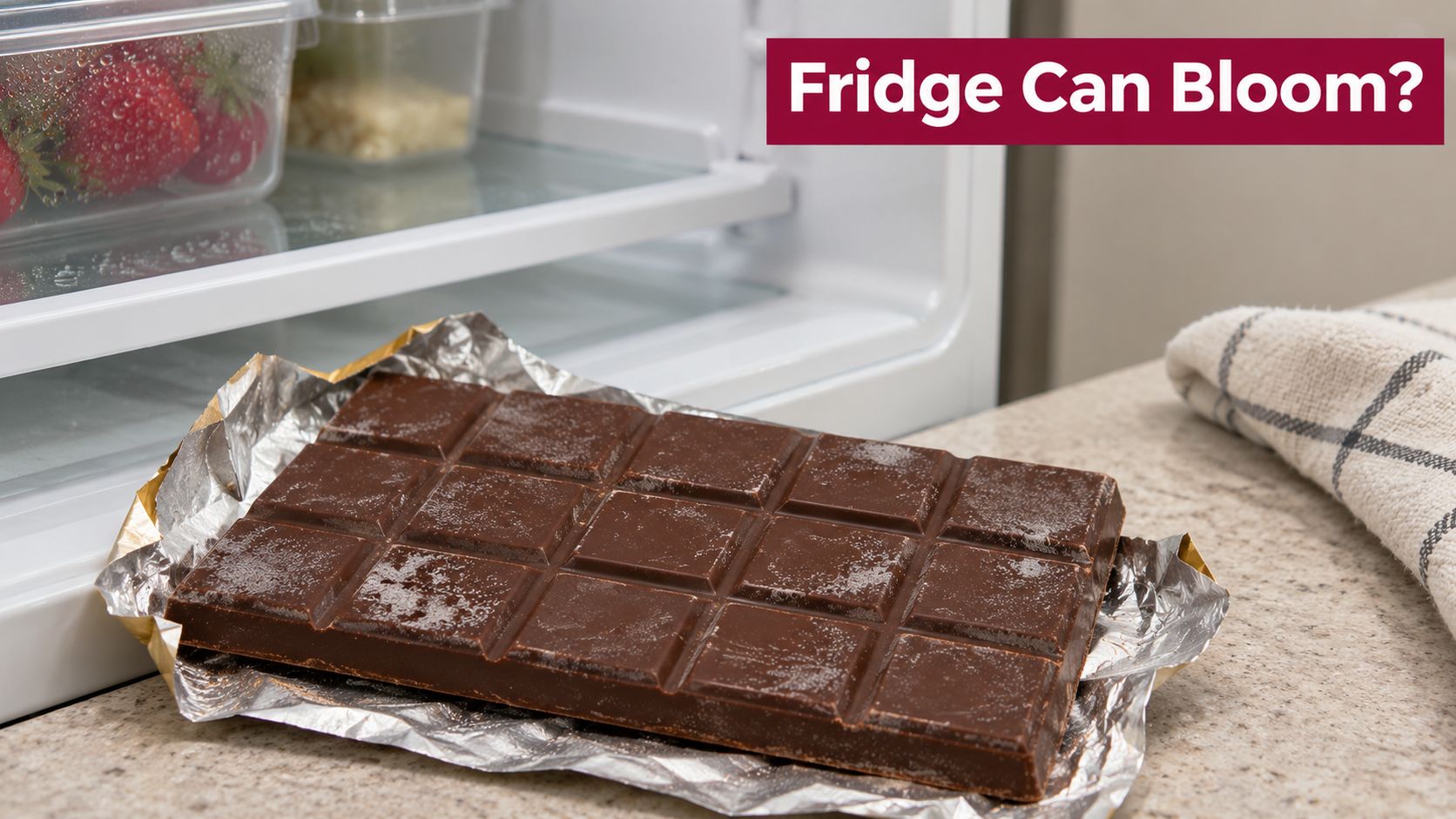
Let the sealed package warm first
- Protect it while cold. Keep chocolate in a moisture-resistant, tightly sealed bag or container.
- Move it while still sealed. Set the closed package somewhere away from sunlight and cooking steam.
- Allow time to acclimatize. Plan on hours rather than minutes; a thick, well-sealed package warms slowly, and the chocolate inside lags behind the container walls.
- Open, taste and reseal. Wait until the chocolate has warmed through, not just until the outside of the container feels less cold.
Why humidity isn't a pass-or-fail number
A published chocolate-storage study found no statistically significant sensory deterioration or sugar bloom in samples held for two months at 8 °C and 70% relative humidity. That finding shows why humidity alone can't predict the outcome; it doesn't mean every refrigerator or package will provide the same protection.
The 65% relative humidity threshold is best treated as a warning for exposed chocolate, not a universal boundary. Package protection, temperature stability and moisture exposure all matter.
The physical threshold for condensation is the dew point: the temperature below which surrounding air deposits water on a colder surface. Cooling-tunnel guidance explains why this relationship matters when cold chocolate enters warmer, more humid air.
Practical rule: Use a cool pantry by default. Use the refrigerator when necessary, with sealed packaging and enough time to warm the chocolate before opening.
Preventing Fat Bloom From Heat and Sun
A bar left in direct sunlight, a warm car or a summer mailbox is on the heat pathway. Warmth softens cocoa butter, the fat that holds the bar's gloss and snap, and later cooling can set those loosened crystals into a rougher pattern that shows as a gray or whitish film.
Fat bloom can appear well before the chocolate looks melted. Each warm-cool swing gives cocoa butter another chance to soften, migrate and recrystallize, so a parcel that heats in transit and cools overnight can bloom even if it never lost its shape.
Keep heat exposure out of the routine
- Carry chocolate in an insulated bag on warm days. Keep it out of the trunk, and bring it with you instead of leaving it in a parked car. Insulation slows heat transfer; it has a limit.
- Keep deliveries out of direct sun. Ask for a shaded drop-off or faster pickup when a parcel is due in hot weather.
- Avoid repeated warm-cool cycles. A steady room is kinder than a spot that warms every afternoon and cools every night.
- Use warm-weather packaging when sending chocolate. Insulation and gel packs buy time, then bring parcels indoors promptly.
- Inspect arrivals promptly. Move chocolate into suitable storage right away. If ours arrives in unsatisfactory condition, contact us immediately and include a photo.
Thin pieces warm through faster because there is less chocolate beneath the surface. The same handling applies to bars, medallions and bark; our guide to what chocolate bark is explains the format, and its large exposed surface can make heat swings show up sooner.
If overheating is part of the history, remove the heat source and let the chocolate rest at a steady temperature. A grayed surface will melt cleanly into baking or drinking chocolate, assuming bloom is the only issue.
What to Do If Your Chocolate Has Bloomed
Bloomed chocolate is still safe to eat, provided bloom is the only issue. It may look unappealing or feel less smooth, but the chocolate itself stays usable.
The Chocolate Academy's humidity-control case study describes sugar bloom as a surface crystallization defect, a quality problem confined to appearance and texture. Bloom changes the surface, so put the chocolate into baking or drinking chocolate instead of discarding it.
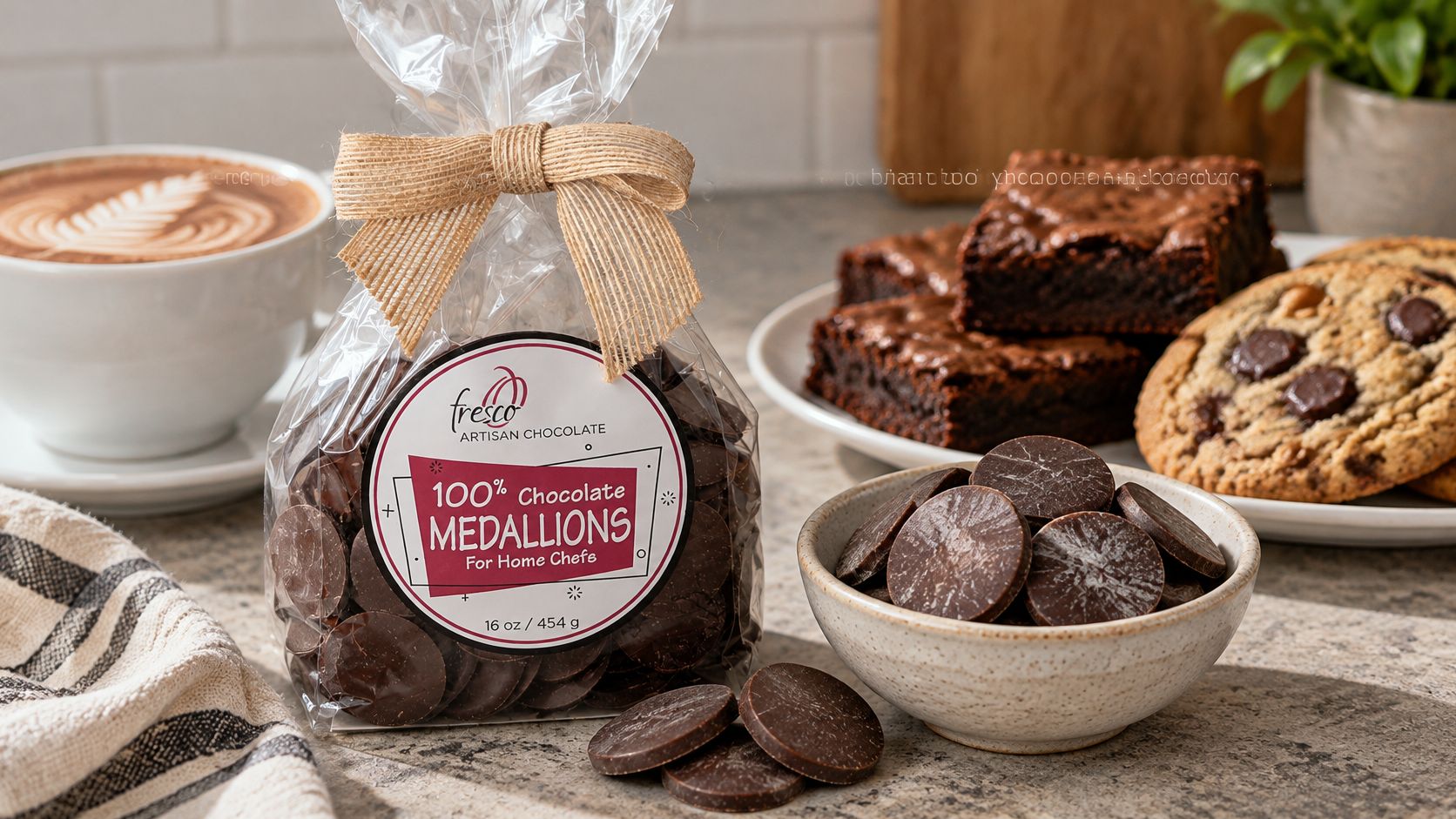
Put it into something you'll enjoy
- Bake chocolate chip cookies. Fresco's chocolate chip cookie recipe is a useful destination for chopped bloomed chocolate. The pieces soften and melt during baking, so the dull surface disappears into the dough. Match the recipe's chocolate type and sweetness before swapping in an unsweetened piece.
- Make drinking chocolate. Follow Fresco's drinking chocolate recipe, whisking the chocolate into the warm liquid. This works especially well for sugar bloom because the liquid dissolves the surface sugar crystals as the cocoa butter melts.
- Prepare a chocolate sauce. Nana's Hot Fudge Sauce recipe uses our 100% Medallions for Baking, Drinking & Tasting, which contain one ingredient, cocoa, with no added sugar. Bloomed unsweetened chocolate melts into the sauce the same way.
That ingredient distinction matters diagnostically, too. A pale coating on unsweetened chocolate is unlikely to be sugar bloom, since there is no added sugar to recrystallize. Check the texture and temperature history before you name the defect.
Check before you cook
Break the chocolate into manageable pieces and inspect it in good light. Discard it if it smells off or shows mold, because those are different problems from bloom. Never taste suspicious chocolate to decide whether it is safe.
If it passes that check, melt gently using dry utensils and a dry bowl, then taste before incorporating it into your recipe. Dry melting leaves sugar grittiness in place, so choose a preparation with liquid when sugar bloom is the likely cause.
The cacao's origin and roast character can still be worth exploring. Our guide to tasting chocolate can help you notice aroma, flavor and finish underneath a dulled surface.
At Fresco Chocolate, we make small-batch, bean-to-bar chocolate for tasting, baking and drinking, and we share recipes to help you use it well. Visit Fresco Chocolate to explore an origin or choose a recipe for the chocolate already in your cupboard, pale patches and all.