
Is Dark Chocolate Gluten Free? How to Check Any Bar
Usually, yes. Plain dark chocolate made from cocoa, cocoa butter and sugar has no gluten ingredients. But a gluten-free recipe does not rule out cross-contact during production. In the United States, a bar labeled gluten-free must contain less than 20 parts per million (ppm) of gluten.
To check a bar, read its ingredients, look for a gluten-free claim, and assess what the maker says about shared equipment. For someone with celiac disease, dark chocolate on the wrapper is not enough.
Dark Chocolate Gluten Status by Product Type
Cocoa percentage describes a bar's composition, not its gluten status. Origin and roast descriptions tell you about the cacao, not whether production equipment handles wheat. See what dark chocolate really means for the distinction.
| Product type | What to check | Practical verdict |
|---|---|---|
| Cocoa, cocoa butter and sugar only | Manufacturing controls | Gluten-free by recipe; confirm cross-contact controls |
| Bar with flavorings | Flavor ingredients and carriers | Check the full ingredient list and maker's statement |
| Bar made on shared equipment | Cleaning and separation | Ask how cross-contact is controlled |
| Bar with malt or cereal crisps | Grain and malt sources | Avoid unless the inclusion is verified gluten-free |
| Bar with cookie, wafer or cake pieces | Inclusion's full recipe | Avoid unless the inclusion is verified gluten-free |
| Bar with a gluten-free claim | Finished-product compliance | Must meet applicable gluten-free labeling rules |
An inclusion can be gluten-free, but its name alone does not establish that. A 2025 peer-reviewed survey of chocolate and chocolate-product respondents found that 91 of 660 respondents (13.8%) reported gluten-related problems. This was a report of respondents' experiences, not a laboratory test of chocolate.
Why Plain Dark Chocolate Starts Gluten-Free
Cocoa beans, cocoa butter and sugar do not naturally contain gluten. A bar made only from those ingredients therefore starts with a gluten-free recipe. The finished bar still depends on its suppliers and production conditions.
Keep three kinds of evidence separate:
- Ingredients: The individual components do not contain gluten by nature.
- Recipe: The maker does not intentionally add gluten-containing ingredients or processing aids.
- Finished product: Supplier and manufacturing controls address unintended gluten exposure.
The FDA's gluten and food-labeling guidance says foods labeled gluten-free must meet ingredient restrictions and contain less than 20 ppm of gluten. That is less than 20 milligrams per kilogram of finished chocolate, not a fixed allowance per bar. The rule also covers the phrases no gluten, free of gluten and without gluten.
A short ingredient list helps, but it does not prove the finished bar meets the gluten-free standard.
Cross-Contact Is the Main Risk
Cross-contact occurs when gluten residue reaches a bar that has no gluten ingredients. Shared scoops, grinding equipment, molds, packaging lines and rework (chocolate returned to production) are possible routes. The Celiac Disease Foundation's cross-contact handout explains why a clean recipe and clean production are separate questions.
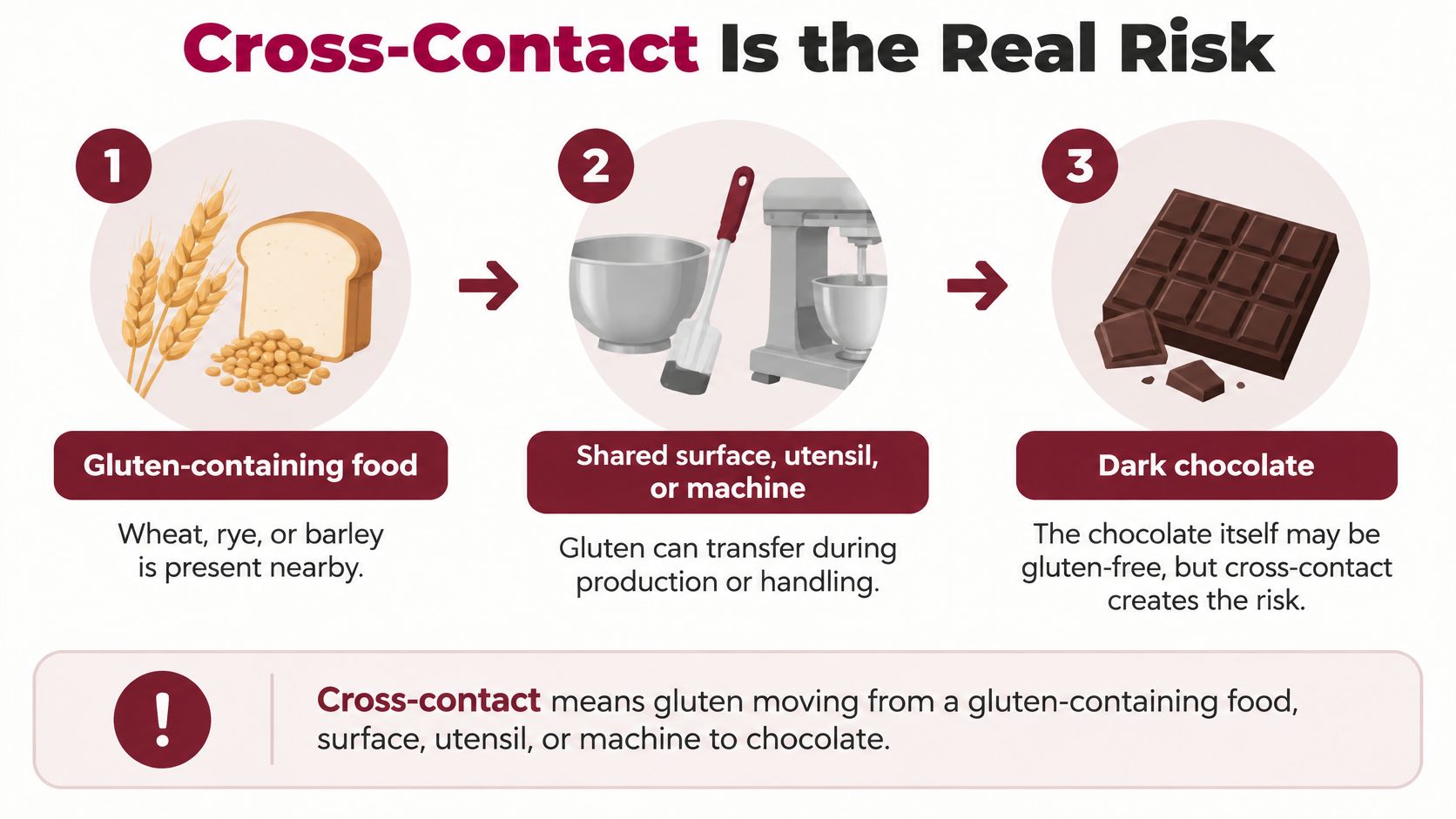
If a maker also produces chocolate with wheat-based cookies or wafers, ask how it controls residue before making plain bars. Useful answers identify:
- Cleaning and separation: How shared equipment is cleaned and checked, or how production is kept separate.
- Ingredient controls: What suppliers disclose about ingredients and their handling.
- Rework rules: Whether chocolate from gluten-containing products can enter another batch.
- Traceability: Whether records connect ingredients and production runs to finished bars.
A shared facility is not proof of contamination. The question is whether the maker can explain controls for the specific bar. Cross-contact can also happen after purchase: DBakerAid™ offers tips to prevent cross-contact when baking.
Ingredient Terms That Hide Gluten
Read the full ingredient list, including components of fillings and inclusions. The FDA's questions and answers on gluten-free food labeling distinguish a regulated gluten-free claim from an assumption based on ingredients. No wheat listed does not mean gluten-free: barley, rye and cross-contact still matter.
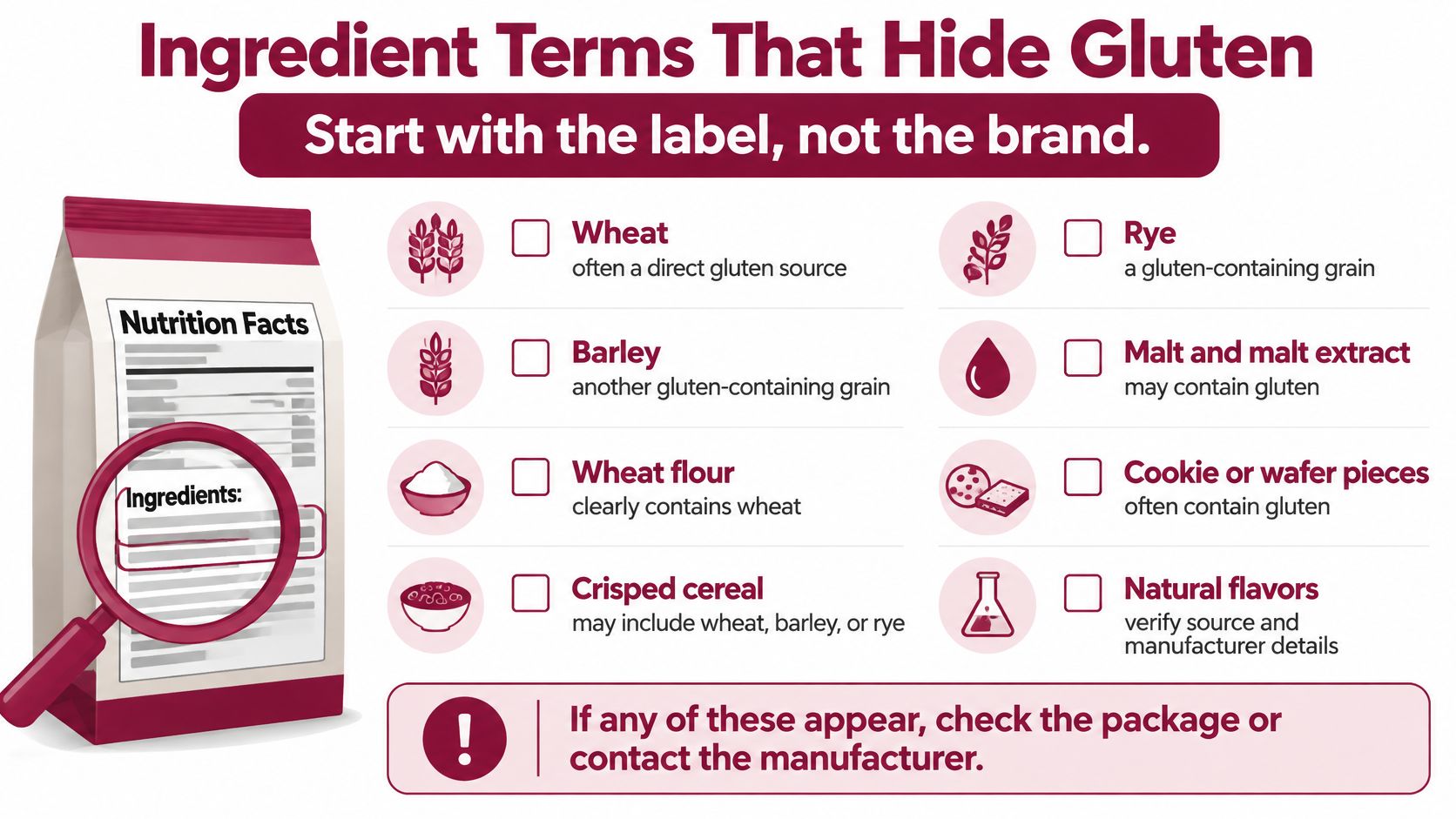
Check these terms closely:
- Wheat, rye and barley: Gluten-containing grains.
- Malt or malt extract: Check the source, particularly when barley is involved.
- Cookie, wafer or cake pieces: Check the inclusion's ingredients.
- Crisped cereal: Check the grain and any malt additions.
- Natural flavors: Not automatically a gluten source, but an unclear source or carrier may warrant a product-specific answer from the maker.
Read package wording literally. No gluten ingredients describes the recipe; gluten-free is a claim about the food under applicable rules. A precautionary shared-facility statement signals a possible concern, not a measured gluten level. Cross-contact may not appear in the ingredient list or Contains statement.
If the label leaves a question open, check the maker's allergen policy or ask about the specific bar. Choose a product with clearer documentation if the answer remains vague.
Allergens Beyond Gluten That Change the Answer
Gluten-free does not mean dairy-free, nut-free, soy-free or vegan. The FDA's dark-chocolate allergen sampling document explains that unintended allergens may not appear in an ingredient list or Contains statement.
| Dietary need | Check for |
|---|---|
| Celiac disease | Gluten-free claim and cross-contact controls |
| Wheat allergy | Wheat ingredients and wheat-handling controls |
| Milk allergy | Milk ingredients and milk cross-contact controls |
| Nut allergy | Nut ingredients and nut cross-contact controls |
| Soy sensitivity | Soy ingredients, including lecithin, and relevant handling details |
| Vegan diet | Animal-derived ingredients, including dairy |
Match the evidence to the need. A wheat-free recipe does not address barley or rye, and a gluten-free claim does not replace wheat-specific checks for someone with a wheat allergy. Likewise, a vegan label does not establish that a bar is safe for someone with a milk allergy.
Verify a Maker's Claim Before You Buy
A recipe statement, a manufacturing policy and a finished-product test answer different questions. Before buying, identify which evidence the maker actually provides.
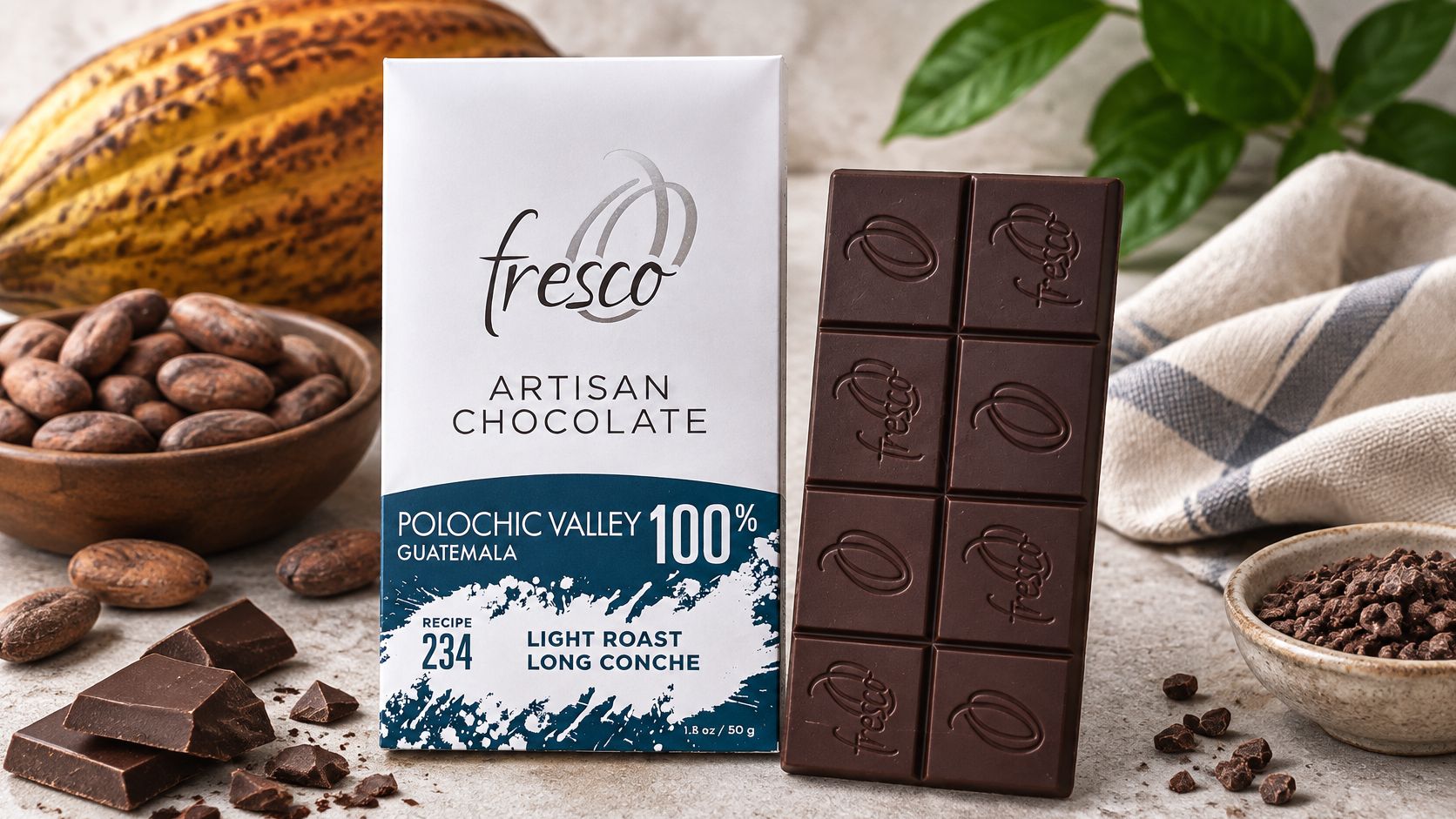
Fresco Chocolate states that its products are free from nuts, dairy, gluten and soy, and its labels carry those statements along with vegan friendly. Review Fresco's food safety page alongside those product claims.
The same distinction applies to independent testing. Maximum Health Products' guide to third party tested supplements discusses testing in another product category. For chocolate, check what was tested, which bar or batch the result covers, and what the test measured before relying on it.
Use this buying sequence:
- Read the ingredients. Check wheat, rye, barley, malt, inclusions and unclear flavorings.
- Check the claim. Distinguish gluten-free from no gluten ingredients.
- Review cross-contact information. Look for answers about shared equipment, cleaning and rework that apply to the bar.
- Match the evidence to your needs. If you have celiac disease or require testing or certification, ask whether the maker has product-specific documentation.
Bottom line: Plain dark chocolate is usually gluten-free by recipe. For a bar you can rely on, check the label and the maker's production controls, especially if you have celiac disease.
Fresco Chocolate publishes free-from attributes for its single-origin dark chocolate. Visit Fresco Chocolate to review its chocolate and food-safety information, and ask product-specific questions before buying.